
SPACE-MEL officially kicks off: Bringing together international expertise in spatial biology and melanoma research
On 5 October 2026, the SPACE-MEL consortium met online for its official kick-off meeting, marking the beginning of four years of interdisciplinary research, collaboration and doctoral training.
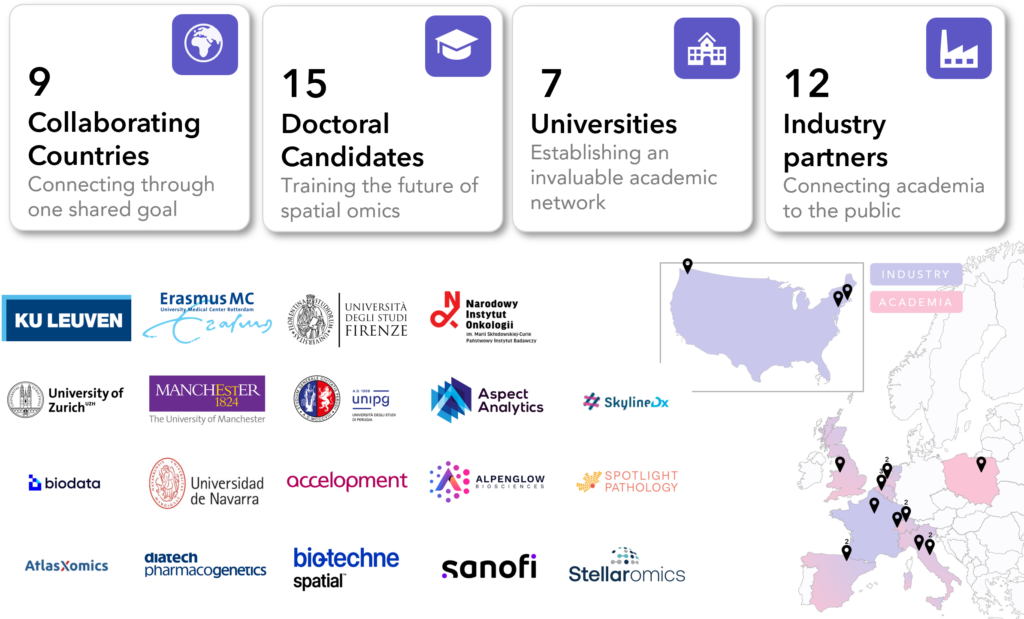
Coordinated by Prof. Francesca Bosisio from KU Leuven, SPACE-MEL (SPAtial single-CEll omics research training for MELanoma precision medicine) is a Marie Skłodowska-Curie Actions (MSCA) Doctoral Network funded under the European Union’s Horizon Europe programme. The project brings together 20 organisations from nine countries, combining expertise from universities, research institutions, clinical centres and industry to advance the application of spatial single-cell biology in melanoma precision medicine.
Setting the stage for interdisciplinary collaboration
The kick-off meeting provided an opportunity for consortium partners to introduce their expertise, discuss their roles and contributions, and align on the project’s scientific objectives and upcoming activities.
At the heart of SPACE-MEL is the ambition to overcome current experimental and computational challenges in spatial biology and translate technological advances into clinically relevant applications. The project’s research activities are organised around four interconnected areas: advancing spatial analysis from 2D to 3D, integrating multiple omics technologies, developing innovative computational and artificial intelligence methods, and translating these approaches into clinical applications for early-stage and mucosal melanoma.
During the meeting, partners discussed how their complementary expertise and technologies will contribute to these objectives. Particular attention was given to coordinating clinical sample collections, harmonising datasets and ensuring close collaboration between experimental, computational and clinical research teams.
Training the next generation of spatial biology researchers
Another central focus of the meeting was the recruitment and training of 15 Doctoral Candidates (DCs), who will conduct individual research projects across the network.
Recruitment is already well underway, with several positions reaching the final stages of selection. The consortium aims to complete recruitment by approximately March 2027, ahead of the first network-wide event planned for June 2027.
Throughout the programme, the DCs will benefit from interdisciplinary supervision, international secondments and a comprehensive training programme combining scientific and technical expertise with transferable skills, innovation and career development. Through close collaboration between academic and industry partners, SPACE-MEL aims to prepare researchers for careers both within and beyond academia.
Looking ahead
The meeting concluded with discussions on project management, communication, dissemination and the next steps for implementation. With the consortium now officially underway, partners will begin coordinating their research activities, preparing shared datasets and establishing the foundations for collaboration across the network.
The SPACE-MEL kick-off marks the first step towards bringing together cutting-edge spatial biology technologies, computational innovation and clinical expertise to advance melanoma precision medicine.
We look forward to sharing the consortium’s progress, introducing our doctoral researchers and highlighting the scientific developments emerging from SPACE-MEL over the coming four years.